The City That Would Not Fall — Until It Did
For eleven hundred years, Constantinople did not fall. Persians tried. Arabs tried. Vikings tried. Bulgars, Rus warriors, and crusaders all tested its walls. Most failed. One group of crusaders succeeded in 1204 — but even they could not hold it forever. The city always recovered, always endured. By the fifteenth century, its survival had become something almost theological. God, many believed, was protecting it personally.
That belief made the spring of 1453 feel like more than a military defeat. It felt like the end of a promise.

A City Already Dying
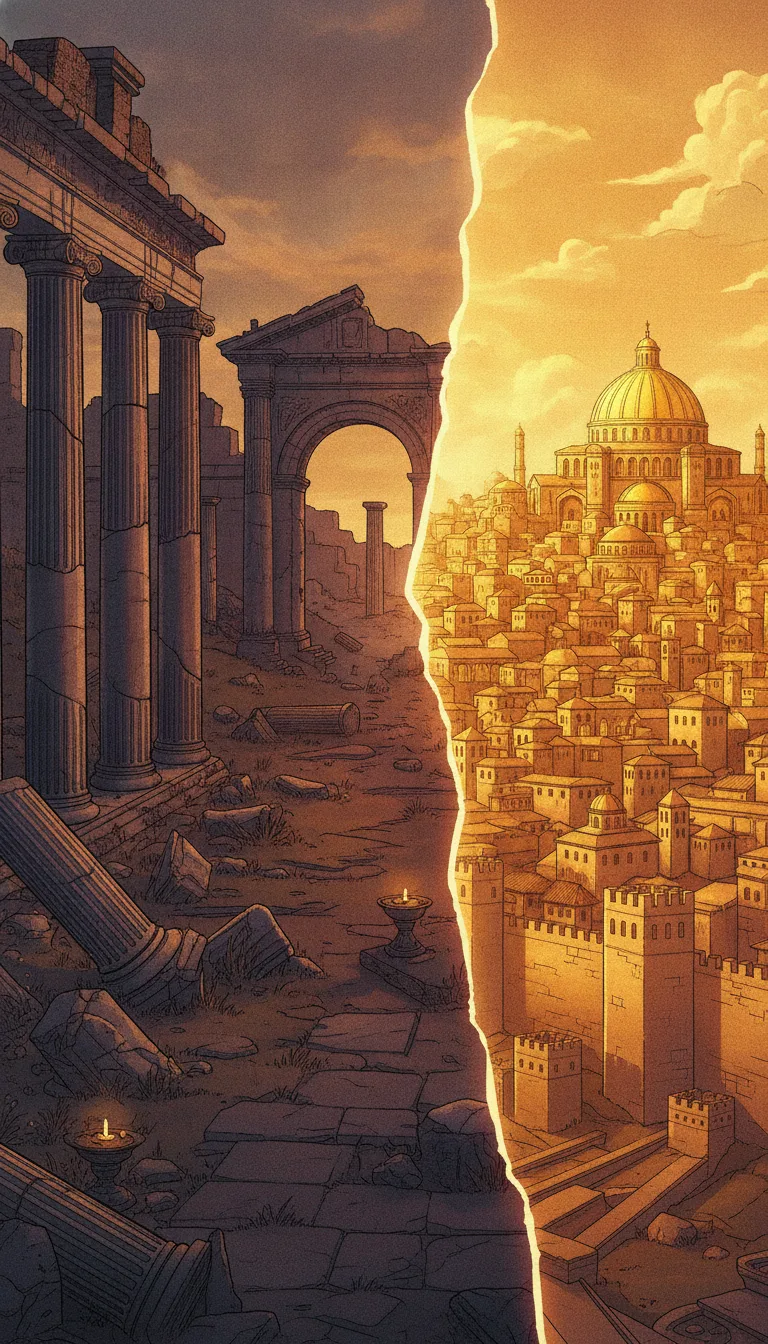
By the time Sultan Mehmed II arrived at the walls in April 1453, Constantinople was already a shadow of itself. What had once been a magnificent metropolis of half a million people had shrunk to perhaps 50,000. Wide avenues that once hummed with trade were overgrown. Churches stood half-empty. The empire that called itself Roman now controlled little more than the city itself, a few Greek islands, and a small strip of the Peloponnese.
Emperor Constantine XI Palaiologos governed a ruin of former glory. He had spent years begging Western Europe for military help, offering to reunite the Catholic and Orthodox churches in exchange for soldiers. The Pope sent a little. Venice and Genoa sent a little. It was nowhere near enough. When the siege began, Constantine had roughly 7,000 men — soldiers, sailors, and armed civilians — to defend nearly fourteen miles of walls.
Mehmed had somewhere between 60,000 and 100,000 troops. Historians still debate the exact number. The imbalance barely matters. The outcome was written before a single shot was fired.

The Gun That Changed Everything
What made 1453 different from every previous siege was technology. Mehmed had commissioned a Hungarian engineer named Orban to build a cannon unlike anything the world had seen. The great bombard — sometimes called the Basilica — could fire stone balls weighing over 500 kilograms. It needed sixty oxen to move and a crew of hundreds to operate. It could only be fired seven times per day because it needed hours to cool between shots.
It was enough. The ancient Theodosian Walls, which had protected the city since the fifth century, were not built for gunpowder. They cracked and crumbled under bombardment they were never designed to survive. The defenders repaired the breaches at night as fast as they could, packing rubble and wooden frames into the gaps. For nearly two months, this exhausting rhythm continued.

The Last Night
On May 28, Constantine XI gathered his commanders and, reportedly, asked forgiveness from anyone he had wronged. He knew what was coming. The final assault began in the early hours of May 29. Wave after wave of Ottoman soldiers struck the walls. The first waves were sent partly to exhaust the defenders. The elite Janissaries came last.
A small unlocked gate — the Kerkoporta — was reportedly found open during the chaos. Ottoman soldiers poured through. Constantine, rather than retreating to the harbor where escape was possible, removed his imperial insignia and charged into the fighting on foot. His body was never definitively identified afterward. A tradition holds that soldiers recognized him only by the golden eagles embroidered on his boots.
What Mehmed Found Inside
When Mehmed II entered the city later that morning, he rode to the Hagia Sophia — for nine centuries the greatest church in the Christian world. The quote attributed to him, taken from a Persian poem about the transience of earthly power, captures something genuine about his reaction. He was twenty-one years old, standing inside a building that had witnessed the baptisms, coronations, and funerals of Roman emperors for nearly a thousand years. Hagia Sophia was converted to a mosque that same day.
Why 1453 Still Matters
The fall of Constantinople marks the conventional end of the Middle Ages in European historiography — though history, of course, does not actually divide itself into neat chapters. More concretely, the Ottoman control of overland eastern trade routes pushed European powers to search for sea routes to Asia, directly accelerating the Age of Exploration. Greek scholars fleeing the fallen city carried ancient manuscripts westward, fueling the Renaissance.
Constantine XI died without an heir, ending the Palaiologos dynasty. There was no successor, no exile government, no continuing thread of Roman authority. A civilization that had lasted, in some continuous form, for roughly 2,200 years — from the founding of the Roman Republic to that May morning — simply stopped.
The Eastern Roman Empire did not fade. It ended on a Tuesday.