The Empire That Refused to Die
In 476 AD, a Germanic chieftain named Odoacer deposed the last Western Roman emperor, a teenage boy named Romulus Augustulus. Most history books mark this as the fall of Rome. But in Constantinople — the glittering city on the Bosphorus — emperors continued to reign, armies continued to march, and Roman law continued to govern millions of people. The Eastern Roman Empire did not fall. It barely flinched.
We call them the Byzantines today, but that label was invented by later historians. The people themselves used one word: Romaioi. Romans. They were not nostalgic imitators of a lost civilization. They believed, with complete sincerity, that they were Rome — the legitimate, unbroken continuation of the empire Augustus had built five centuries earlier.

A Civilization at the Crossroads of the World
Constantinople was arguably the most important city on earth for nearly a thousand years. Sitting at the junction of Europe and Asia, it controlled the trade routes connecting the Mediterranean to the Black Sea. Merchants from China, Persia, Scandinavia, and Africa passed through its markets. At a time when London was a muddy provincial town and Paris was barely a settlement, Constantinople had running water, hospitals, universities, and a population of several hundred thousand people.
The Byzantines were not merely preserving the past — they were building on it. Emperor Justinian, who ruled in the sixth century, commissioned the Corpus Juris Civilis, a comprehensive codification of Roman law that remains the foundation of legal systems across Europe and Latin America today. His architects built the Hagia Sophia, a cathedral so structurally innovative that engineers still study it. For nearly a thousand years, it was the largest enclosed space in the world.
The empire also pioneered something remarkably modern: diplomacy as a science. Rather than simply fighting every enemy, Byzantine emperors developed sophisticated networks of alliances, intelligence gathering, and strategic marriages. They played their neighbors against each other with patience and precision. This was not weakness — it was survival intelligence.

A Thousand Years of Holding the Line
The Byzantine Empire faced existential threats on a scale that is difficult to overstate. Persians, Avars, Arabs, Bulgars, Normans, Crusaders, Mongols, and Turks all pressed against its borders across the centuries. The famous Theodosian Walls of Constantinople — triple layers of stone and brick built in the fifth century — were never breached for a thousand years. The empire shrank, contracted, and sometimes nearly vanished, but it endured.
This endurance had consequences for all of Europe. When Arab armies expanded rapidly in the seventh and eighth centuries, it was Byzantine resistance that slowed their advance into southeastern Europe. When the empire finally fell, scholars and theologians who fled westward carried manuscripts of ancient Greek philosophy, mathematics, and medicine — knowledge that had been safeguarded in Constantinople's libraries while much of Western Europe was rebuilding from the ruins of the old empire.

The Last Morning
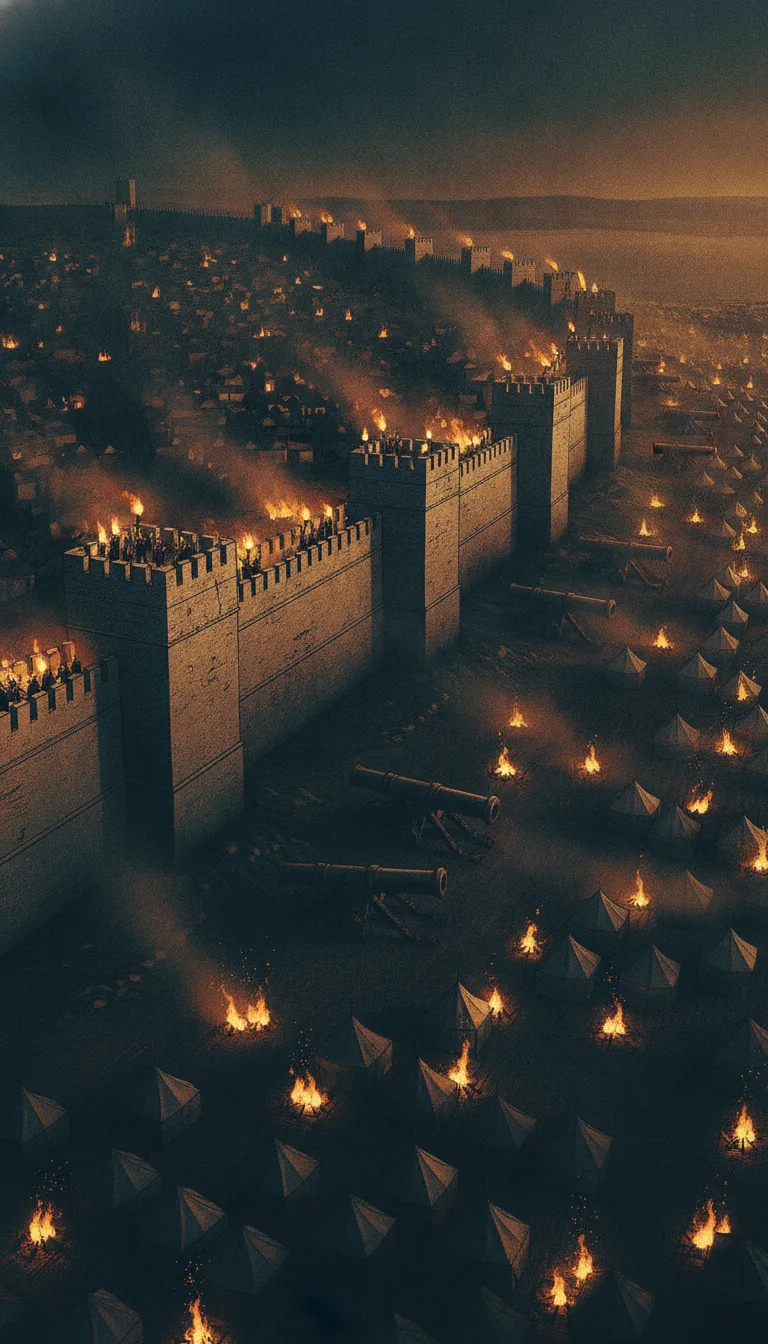
By 1453, the Byzantine Empire had been reduced to little more than Constantinople itself and a few scattered territories. The Ottoman Sultan Mehmed II, just twenty-one years old and ferociously ambitious, assembled an army estimated at between 60,000 and 80,000 men, along with massive bronze cannons capable of hurling stone balls weighing hundreds of kilograms — technology that made the ancient walls suddenly vulnerable.
Emperor Constantine XI Palaiologos had perhaps 7,000 defenders, including Genoese mercenaries who fought alongside Greeks out of shared desperation. Constantine reportedly refused offers to escape by ship. On the morning of May 29, 1453, after a siege of fifty-three days, Ottoman forces finally broke through. Constantine tore off his imperial insignia and charged into the fighting. His body was never definitively identified.
Mehmed rode into the city that afternoon and walked through the Hagia Sophia. He was reportedly moved to tears — and immediately ordered it preserved as a mosque rather than destroyed.
Why It Still Matters
The fall of Constantinople sent shockwaves across the Christian world, but its longer consequences were quietly transformative. Byzantine scholars who emigrated to Italy brought with them Greek texts that Western Europeans had not read for centuries — Plato, Aristotle, Euclid, Homer in the original language. They taught Greek in Florence and Rome, helped establish printing presses, and contributed directly to the intellectual explosion we call the Renaissance.
The Byzantine Empire is often treated as a footnote to Roman history, or a curiosity between ancient and modern worlds. But it was something rarer: a civilization that lasted eleven centuries, absorbed countless blows, and even in its final collapse, managed to give the world something extraordinary.
That is not a footnote. That is a story.